They need to have 15 years of mainstream banking experience

Many from this small lender have made it to other bank boards over the past 5 years

The central government and the Reserve Bank of India have devised a country-specific plan towards implementation of overseas trade in rupee, people aware of the matter said. To start with, a small number of banks will be allowed to manage cross-border transactions in domestic currency with a particular country. "Small countries that are dollar-deficient have shown interest in doing trade in rupee.


The meeting will review annual financial performance of public sector banks, credit offtake in the economy, priority sector lending and progress made under various social sector schemes, including Atal Pension Yojana (APY) and Pradhan Mantri Jan Dhan Yojana.

The minimum lending rate, or base rate, is what a bank can charge from a customer. The new regime, which will come into play from July 1, is intended to bring about more transparency in the lending operations of banks.

The protesting farmers' main demand to legalise the minimum support price (MSP) regime has divided opinion. One school of thought says it would lead to crop diversification and help India keep under check its burgeoning import bill on edible oils and pulses, while another says it would incentivise farmers to produce low-quality crops. Contrary to popular perception, India has a trade surplus in agriculture and allied activities, which stood at $18.65 billion during 2022-23 (FY23) against $15.92 billion in the previous year. However, the surplus was mainly on account of rice, wheat, sugar, spices, and buffalo meat.

Shares of Adani group firms have faced heavy drubbing since Tuesday's close last week, after US-based short seller Hindenburg Research made damaging allegations against the conglomerate. Most of the group firms fell for the third day running on Monday. Since Tuesday's close last week, shares of Adani Transmission have tumbled 41.66 per cent, Adani Total Gas tanked 39.57 per cent, Adani Green Energy declined 37.55 per cent and Adani Ports fell 23.75 per cent on the BSE.

The strike call is over privatisation, mergers, and also due to write-off of corporate NPAs, criminalisation of willful default

Since March 31, 2022, the PSBs' market cap has risen 43.7 per cent, from Rs. 7.29 trillion to Rs. 10.47 trillion. It's time for the government, the majority owner of public sector banks, to reap the benefit of the rally in bank stocks, recommends Tamal Bandyopadhyay.

Bank of India, Canara Bank, Dena Bank, Corporation Bank and Andhra Bank are among the lenders that received capital infusion from the government.
The central bank has nine executive directors, and one of them -- S Karuppasamy -- retired recently. R Gandhi, who was executive director, has now been promoted to the post of deputy governor.

The government is set to earn an equity dividend of nearly Rs 13,800 crore from the listed public-sector banks (PSBs), all 12 of them, for FY23, up 50 per cent from Rs 9,210 crore in FY22. This will be the highest ever dividend for the government from PSBs. The 12 PSBs in our sample are paying an equity dividend of nearly Rs 21,000 crore for FY23, up 53 per cent from Rs 13,710 crore for FY22.

While the formation of a holding company will not outright privatise State-owned banks, officials believe it will help the Centre deflect criticism arising out of the latest banking scams.

Bond markets, global as well as domestic, are likely headed towards hard times over the next three to six months, as higher vegetable prices, rising fuel costs, and improved wages may keep inflation hot, believe analysts, who expect the yields to hit 7.5 per cent in the near-term from the current 7.234 per cent. In this backdrop, they suggest investors can put in money in funds/instruments with residual maturity of 4 to 6 years, while longer-term investors can allocate cautiously to the longer end in the range beyond 7 years.
Bank stocks took a hammering today as the Centre said it was not in its policy to take back its equity from public sector banks at par value.
You cannot do much to ensure that the documents banks take from you before giving a loan do not get damaged

Despite high headline numbers, the output of one-third of the segments in the manufacturing sector in August stood below even that in the same month in 2011-12, when the new index of industrial production (IIP) series started. This is despite the fact that manufacturing grew 9.3 per cent in the month, driving up IIP growth to a 14-month high of 10.3 per cent. Part of it is due to the devastation of these product categories by lockdowns induced by Covid waves and subdued export conditions, while part of it needs to be assessed further.

The meeting is expected to chart a road map for cleaning up their balance sheets and boost credit flows, reports Somesh Jha.

Moody's Investors Service on Thursday downgraded subordinated debt ratings of 11 Indian banks, including SBI, ICICI Bank and HDFC Bank.
The Reserve Bank of India (RBI) will maintain the policy repo rate at 6.5 per cent during its upcoming June 8 announcement, considering the easing of retail inflation in April and the potential for further decline, indicating the effectiveness of previous policy rate actions, anticipate experts. Headed by Reserve Bank Governor Shaktikanta Das, a meeting of the six-member Monetary Policy Committee (MPC) is scheduled for June 6-8. The decision of the 43rd meeting of the MPC would be announced on Thursday, June 8.

Some of the public banks showed improvement; much more still needs to be done

The evolving RBI-government relationship, a reversal in the interest rate cycle and return to profitability will dominate bankers' conversation this year, says Tamal Bandyopadhyay.

'We can't have the best of both worlds -- large, efficient, world class government-owned banks, doing social banking and making profits. 'Why not set them free from the shackles of such obligations and run them as business units?' says Tamal Bandyopadhyay.
The pilot project for central bank digital currency (CBDC) in the retail segment went live on Thursday with the Reserve Bank of India (RBI) issuing Rs 1.71 crore to four participating banks based on their indents. The central bank has identified four banks for the first phase of the pilot - State Bank of India, ICICI Bank, Yes Bank and IDFC First Bank - in four cities, Mumbai, New Delhi, Bengaluru and Bhubaneswar. The highest indent was received from one private sector bank.
.jpg)
Bank stocks have underperformed in the second quarter of FY'14 with the BSE Bankex declining 18 per cent compared to fall of 1 per cent in the BSE 30-stock index, Sensex, during this period.

In a message to public sector banks (PSBs) that only performers will survive, the government, in an unprecedented move, has decided to allocate capital to only nine PSBs.
After upgrading India's foreign currency debt rating, Moody's Investor Service on Wednesday upgraded the foreign currency deposit, debt and issuer ratings for 11 Indian banks and financial institutions.

Bigger state-run banks such as Bank of Baroda, Punjab National Bank and Union Bank have also seen their bad loans rising in the December quarter.
The new interest rates will be effective from August 19 and will be applicable to both resident and non-resident customers.

Though most experts remain bullish on the banking space, they suggest investors buy only those banks whose NPAs are at a manageable level of 3% to 4% and there is credit growth or earnings visibility.

The mergers will not involve any cash but only share swaps
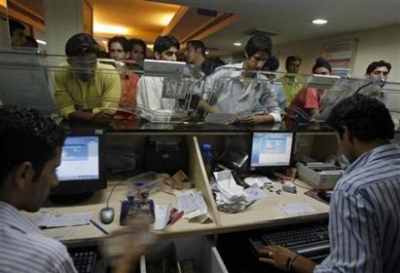
Punjab National Bank, Bank of Baroda, Bank of India and Canara Bank already charge their customers a levy for failing to maintain a minimum balance for a quarter or a month.

Amul's move is being seen by many, especially opposition parties, as a threat to KMF's famed dairy brand 'Nandini'.

Did you know that your home insurance covers valuables in bank locker?

The post of chairman and managing director has been split and the government has appointed managing directors and chief executive officers in four banks -- Indian Overseas Bank, United Bank of India, Oriental Bank of Commerce and Vijaya Bank.

Banking shares are down up to 11% after the Reserve Bank of India has increased the policy repo rate by 25 basis points from 7.25% to 7.5% with immediate effect.

'Investors should not commit fresh money to these stocks right now, unless they can hold for the next three to four years.'
